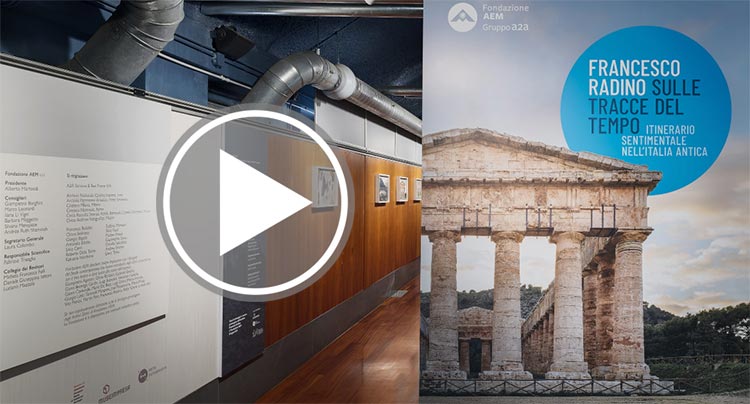
This exhibition marks the beginning of a broader initiative to bring the photographic work of Francesco Radino into focus. His archive is now held at the Historical Archives of Fondazione AEM. Bringing together two complementary strands, the exhibition pairs the photographer’s final body of work, devoted to a number of archaeological sites in Sicily, with photographs from earlier series made in China, Ireland, Guatemala, Italy, Japan, Palestine and Egypt. Identified during the ongoing cataloguing of the archive, these images reveal Radino’s enduring fascination with the ancient world and provide the starting point for a historical and critical exploration of this recurring theme in his work.
In October 2021, during a journey through Sicily with his wife, Cristina Omenetto, Radino created a colour series exploring the traces of antiquity that continue to shape the landscape.
Archaeological remains enter into dialogue with the natural environment, bringing nature and culture into relation. These two “souls” of reality lie at the heart of Radino’s reflections on habitat: the setting in which human beings build societies and shape history.
The title, conceived by the photographer and rediscovered during the reorganisation of the archive, brings together several interconnected ideas: the notion of the trace, shared by archaeology and photography; the passage of time; the experience of travel; and an unmistakably emotional way of looking at the world. The reference to Italy also suggests Radino’s intention to extend his investigation to other archaeological sites across the country.
The journey takes in Catania, Mount Etna, Syracuse, Agrigento, Selinunte, Mozia and Segesta. The unsettled weather gives rise to veiled skies, unusual plays of light and shadow, and subdued colours, far removed from the familiar brilliance of the Mediterranean. These atmospheric conditions lend the photographs their contemplative, subtly uncanny quality, as though they were evoking something distant, suspended between memory and unreality. True to his distinctive approach, Radino alternates expansive views, exploring the relationship between architecture and its surroundings, with close-up studies of textures, materials and forms. The latter lend the images a pronounced tactile quality.
The journey may be understood as a return to the southern roots of his father, Vincenzo, a distinguished painter from Basilicata who was, in many respects, Radino’s mentor. More broadly, it becomes an occasion to reflect on the civilisations from which we have emerged, at a time of profound social and cultural change.
The exhibition also evokes the tradition of the Grand Tour. Between the seventeenth and nineteenth centuries, intellectuals, artists, and young aristocrats and members of the bourgeoisie would bring their journeys of cultural discovery to a close in southern Italy. Through writing, painting and, eventually, photography, they sought to capture and recount their encounters with an extraordinary historical, artistic and natural landscape.
Roberta Valtorta
|